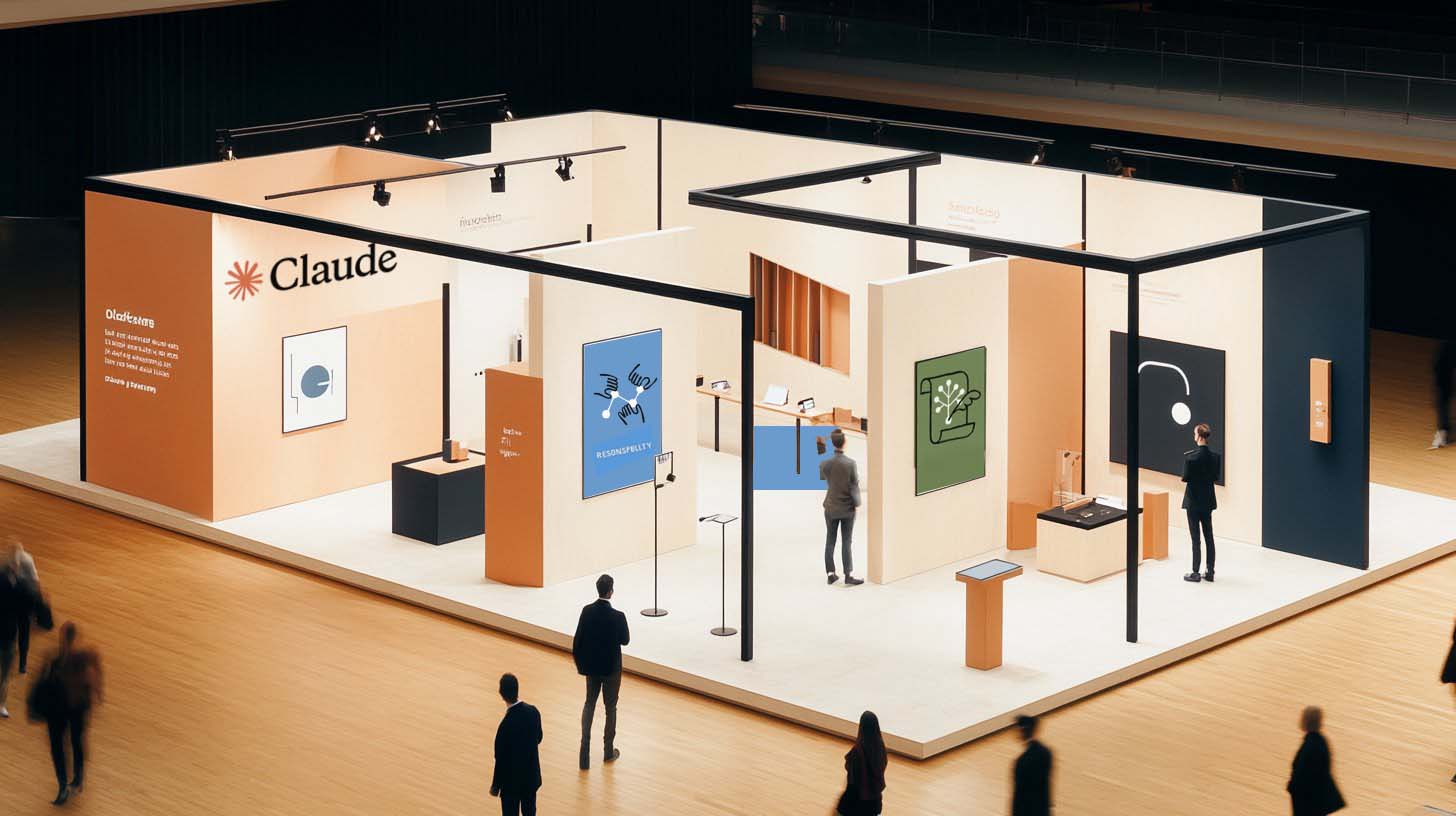
How might Anthropic show up at a conference — not to sell, but to invite a different kind of conversation about AI? A speculative event concept exploring spatial design, brand experience, and the attendee journey.
Most conference booths compete on volume — bigger screens, louder graphics, more aggressive lead capture. The result is a floor of undifferentiated noise where every company looks the same.
Anthropic is different. Their brand is built on restraint, intellectual honesty, and a belief that AI should be safe and beneficial. Their visual identity reflects this: warm, muted, typographic, unhurried. The brief I set for myself was simple — design a conference presence that feels like Anthropic, not like a trade show.
The concept: a space that rewards curiosity over conversion. An environment where attendees slow down, engage with ideas, and leave with a lasting impression of a company that thinks differently about AI.
Use restraint as a competitive advantage. While competitors fill every surface with messaging, create negative space that draws people in. The quietest booth on the floor becomes the most magnetic.
Frame the experience more like visiting an exhibition than attending a sales pitch. Encourage exploration and discovery rather than a linear sales funnel. Let people find their own path.
Use real materials — oak, linen, concrete, felt — that you can touch. In a sea of printed vinyl and aluminum extrusion, natural materials communicate craft and intentionality without saying a word.
Instead of hiding infrastructure, let the construction be part of the design language. Exposed steel frames, visible joinery, and honest structure echo Anthropic's commitment to transparency.
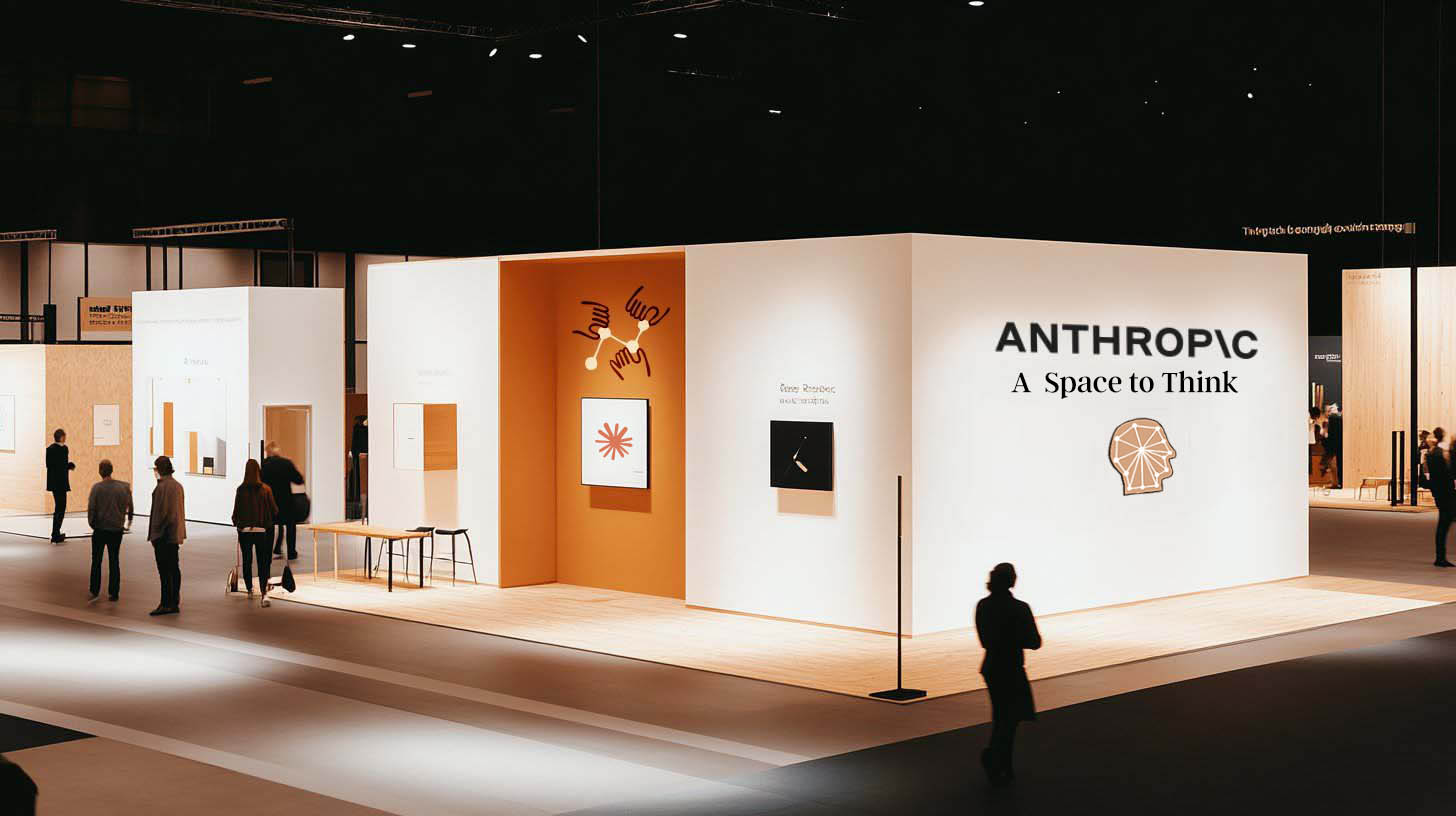
The first moment matters most. From across the hall, the booth reads as a clean white volume — more gallery than trade show. The exterior walls are deliberately spare: warm off-white surfaces with the ANTHROPIC wordmark set large and confident on the corner face. No taglines, no product screenshots, no QR codes. Just the name, and a series of framed compositions mounted along the facade like an outdoor exhibition.
The artwork on the exterior walls does double duty. Each piece — abstract geometric forms in terracotta, black, and warm neutrals — functions as a visual identity system and a reason to slow down. A deep terracotta alcove punctuates the white facade, creating a threshold moment: a warm glow that pulls you off the conference floor and into the space. The oak flooring begins at the entrance, and you feel the material shift underfoot before you consciously register that you've stepped inside.
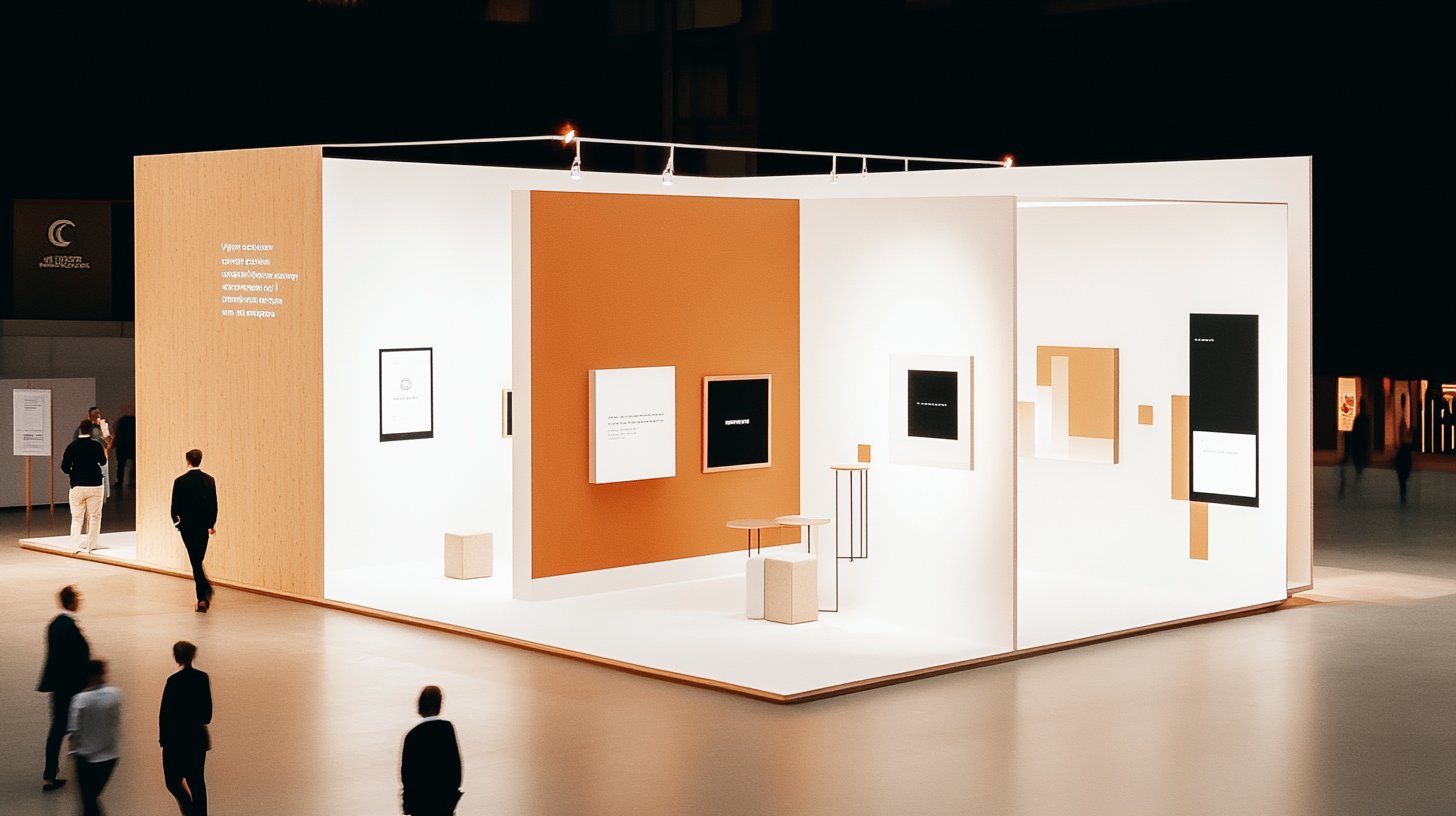
Once inside, the first thing you encounter isn't a product demo or a sales rep — it's a curated wall of ideas. Large-format typographic panels present Anthropic's thinking on AI safety, alignment, and responsible development. Not marketing copy. Actual ideas, presented with the care of a gallery exhibition.
The wall uses a modular panel system that can be reconfigured for different events and updated as Anthropic's research evolves. Each panel pairs a provocative question with a concise point of view — designed to be read in under 30 seconds but thought about long after.
Anchoring the Discovery Wall is a perceptual illusion — a large-format illustrated head in profile, its mind opening into a network of nodes and connections. The visual language is deliberate: the branching points mirror vector embeddings — the way AI models map relationships between concepts in high-dimensional space. What looks organic is actually structured, and what looks like art is actually a diagram of how Claude thinks.
From a distance, the illustration appears printed directly on the wall. But as attendees approach, the illusion reveals itself: the nodes are actually suspended in space, drifting slowly in front of the surface. The effect is built with projection mapping and transparent acrylic elements mounted at varying depths. From the front, everything reads as a single flat composition. Move to the side, and the layers separate — the mind stays fixed while the network floats free, occupying real three-dimensional space just like the vector points it represents.
A note on feasibility: The full execution — rear-projection mapping with synchronized acrylic suspension elements — requires partnership with a specialized experiential AV studio. I'd spec this during a two-week technical discovery phase, including a proof-of-concept test at the fabricator's shop before committing to the full build. The concept is designed to scale gracefully: a pre-rendered LED version or a static dimensional mural both preserve the core idea at lower technical and budget thresholds. The creative intent — flat from the front, dimensional up close — holds regardless of the execution tier.
For a tighter budget or faster turnaround, the same illustrated head and mind network can be delivered entirely through front-projection onto a flat matte surface. The animation — nodes drifting, connections pulsing — is pre-rendered and looped, eliminating the need for suspended acrylic elements and rear-projection rigging. The wall becomes a single surface with a single projector, dramatically reducing AV complexity and cost.
The tradeoff is dimensional depth — the projection version reads as a flat animated mural rather than a layered perceptual illusion. But the core experience holds: attendees still encounter the mind network, still see the vector relationships mapped visually, and still pause at a moment of unexpected craft on the conference floor. At roughly 40% of the premium version's AV cost, this is the execution I'd recommend for a first deployment or a mid-tier event footprint.
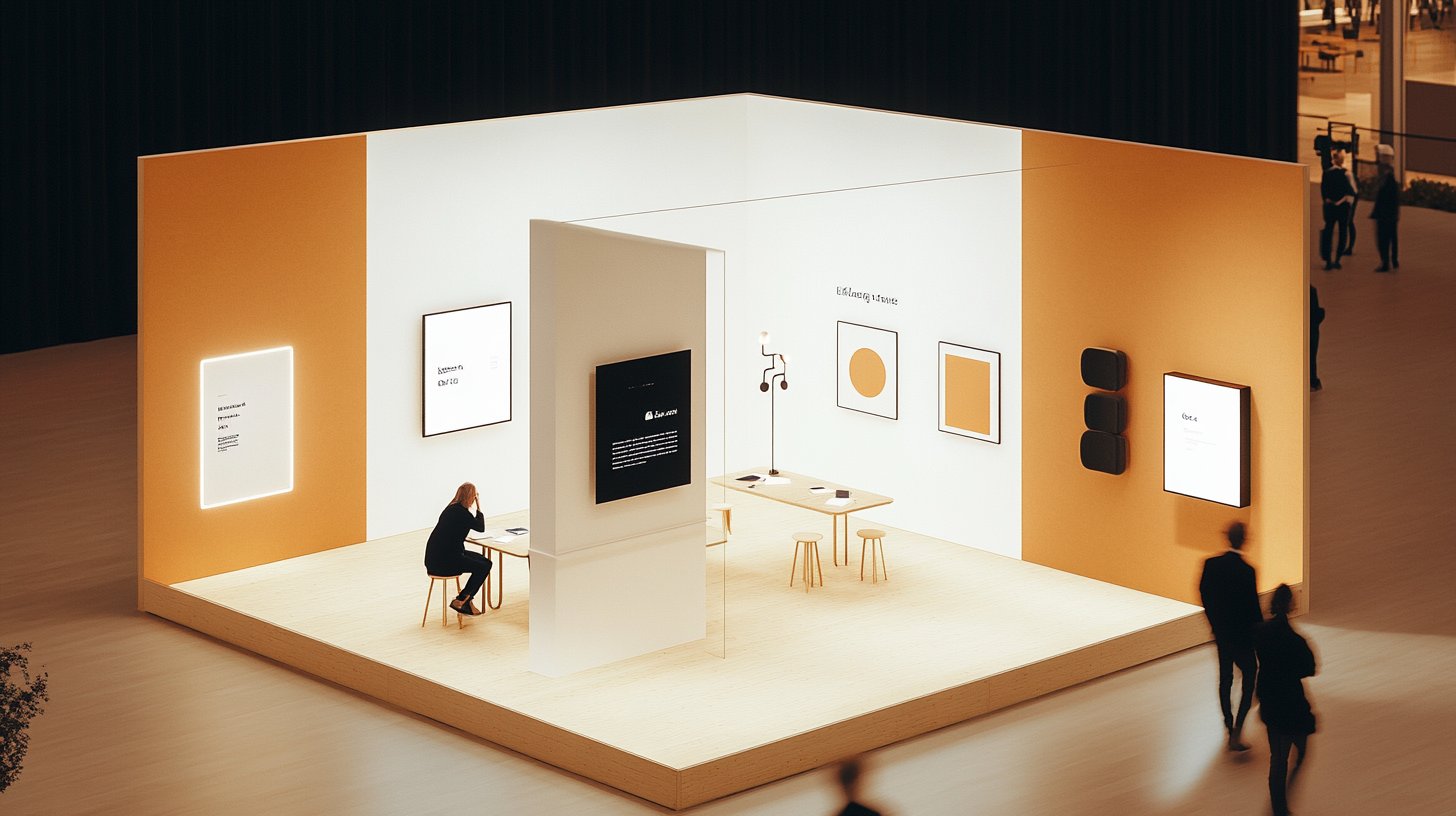
The hands-on zone, but designed to feel like a workshop rather than a kiosk. Small oak tables seat two or three people at a time — intimate enough for a real conversation, not a scripted demo. A central divider wall anchors the space with a screen showing Claude in action.
The key design decision: no standing demo stations with screens on poles. Instead, the interaction happens at seated height, at conversation speed. Attendees sit alongside an Anthropic team member rather than across from them. The spatial arrangement says "let's explore this together" rather than "let me show you what this does."
A semi-enclosed space for 20–30 seated attendees, designed for short talks and fireside conversations. Wooden bench seating reinforces the informal, intellectual tone. The stage itself is barely elevated — a low platform that puts the speaker at eye level with the front row.
The backdrop is a single large projection surface with generous margins. Presentation slides follow the same typographic restraint as the rest of the space — no bullet points, no stock photography, just well-set type and the occasional diagram. The architecture of the stage area uses taller wall panels to create acoustic separation from the main floor without fully enclosing the space.
The final zone is intentionally quiet — a place to sit, process, and have an unstructured conversation. Low seating with natural linen upholstery. Small side tables with printed booklets and research summaries. A few plants. No screens.
This is the zone most conference booths forget: the moment after the demo, after the talk, when someone decides whether this company is worth following up with. By giving attendees a comfortable place to decompress within the Anthropic space, the brand gets the most valuable thing at a conference — extended dwell time and authentic conversation.
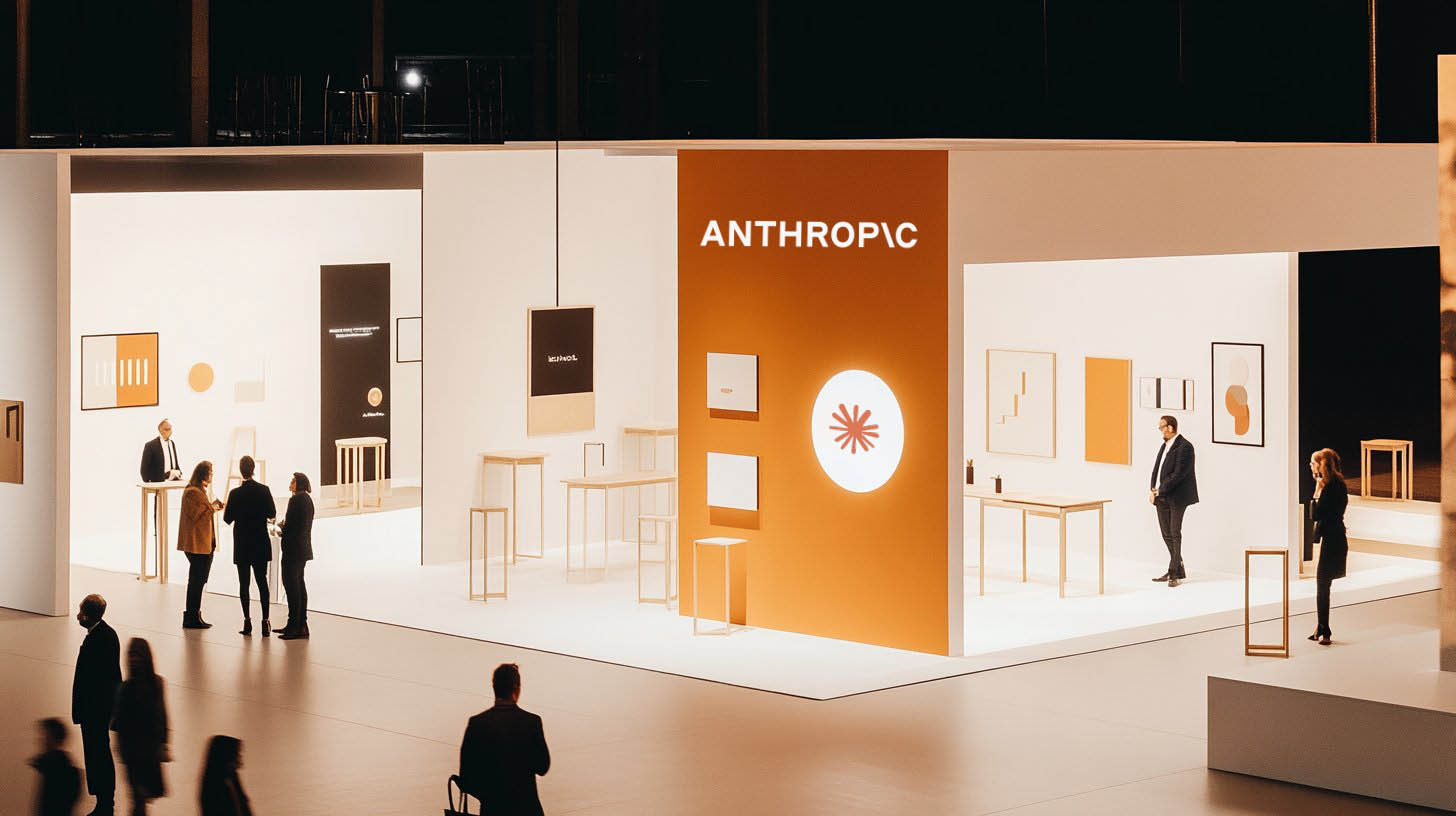
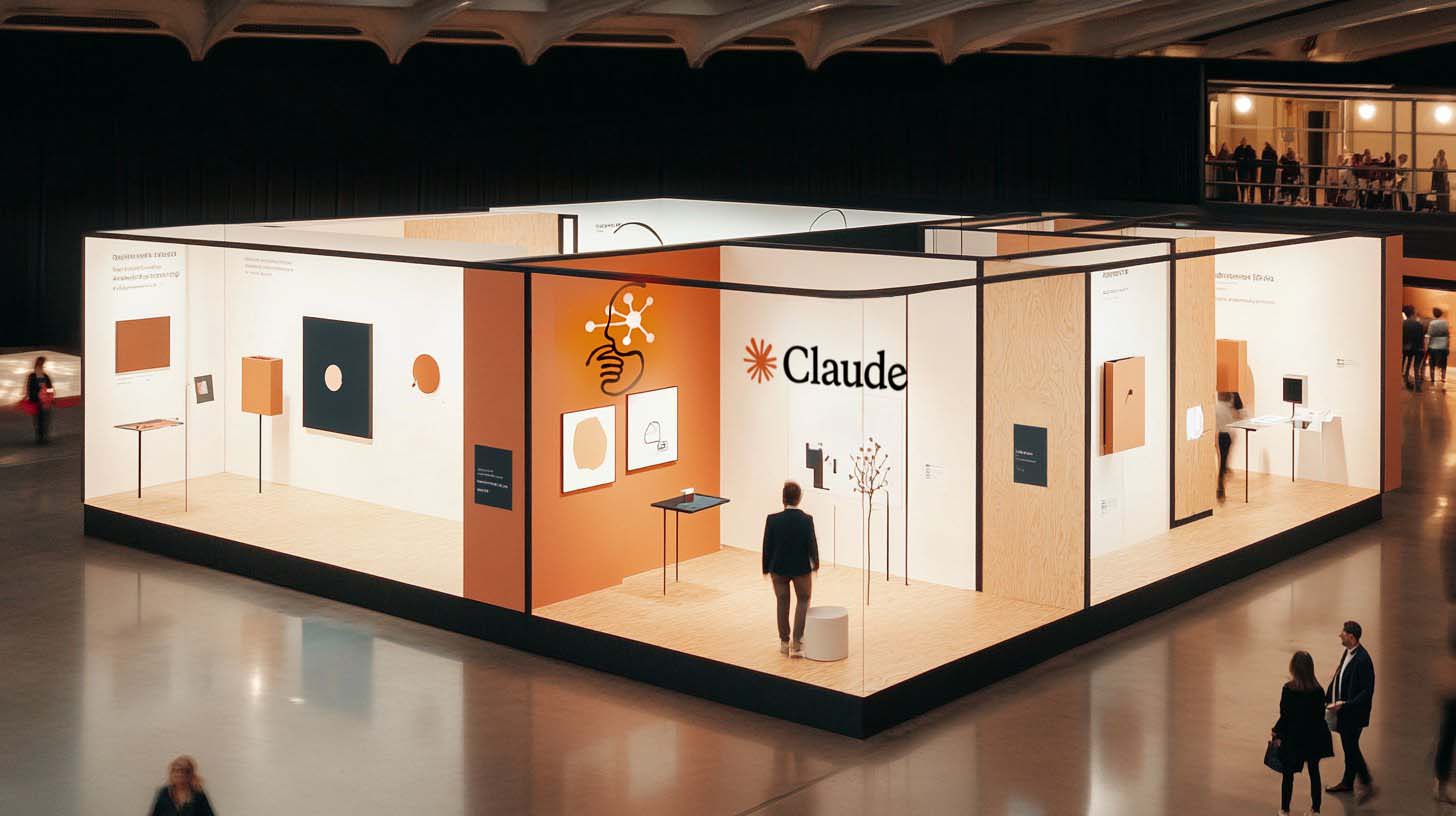
The concept is designed as a 40' × 40' island configuration — open on all four sides with primary entry from the main aisle. This footprint accommodates the full six-zone journey while maintaining generous circulation paths (minimum 5' clear width) that prevent bottlenecks during peak floor hours.
The layout is organized around a central spine running east-west, with the Talk Stage anchoring the back-left quadrant and the Decompression Lounge occupying the back-right. The Threshold and Discovery Wall face the primary aisle to maximize first-impression visibility, while the Interactive Wall sits at the interior hinge point — visible from outside but requiring entry to fully experience.
All structural elements — the steel frame, wall panels, and flooring system — are designed around standard crate dimensions for efficient freight. The oak flooring uses a raised modular platform system (SnapLock or similar) that installs without adhesive over the convention center's existing floor, keeping load-in clean and damage-deposit-free.
Tables, benches, signage panels, and trim. Quarter-sawn for tight grain. Finished with a matte clear coat to preserve natural warmth without sheen.
Seating upholstery and scrim panels. Unbleached, medium-weight. Creates soft acoustic dampening and tactile warmth throughout the space.
Flooring base. Sealed and polished to a matte finish. Provides a grounding material that contrasts with the warmth of wood and textile above.
Structural frame, shelf brackets, and lighting track. Powder-coated to a flat finish. Provides graphic contrast and industrial honesty.
Accent walls and wayfinding surfaces. A warm, earthy tone that anchors the palette and provides contrast against off-white walls without competing for attention.
Acoustic panels and pinboard surfaces. Charcoal and warm gray tones. Functional sound dampening that doubles as a refined graphic texture.
A concept only matters if it can be built, shipped, and installed on a deadline. This section outlines how the design translates to production — the budget framework, logistics, vendor strategy, and the decisions I'd make when constraints get tight.
At this footprint and finish level, the build falls in the $250K–$350K range for a first deployment, including design development, fabrication, AV integration, graphics production, freight, I&D labor, and on-site supervision. Key cost drivers are the custom oak millwork, the Interactive Wall's AV system, and the raised flooring platform. Subsequent deployments of the same structure drop significantly — roughly $80K–$120K per show — covering freight, I&D, updated graphics, and any AV rental refreshes.
The material palette was chosen with amortization in mind. Oak millwork, steel frame, and concrete-finish flooring are durable across 8–12 deployments before showing wear. Linen upholstery and felt panels are replaceable components on a per-show basis at low cost. Graphics and typographic panels use the modular Z-clip system, so content updates don't require structural changes.
The 40 × 40 island is designed for a two-day install with a standard union crew of 8–12. Day one covers structural steel, flooring platform, and electrical rough-in. Day two handles millwork, graphics, AV calibration, furniture placement, and a lighting focus. The steel frame uses bolted connections (no welding on-site) and all wall panels are pre-finished and crated to final dimensions — minimizing on-floor fabrication time.
Freight estimate: 6–8 standard crates plus AV road cases. For West Coast shows (NeurIPS, for example), I'd recommend warehousing with a fabrication partner in LA or the Bay Area to reduce cross-country freight costs. East Coast shows route through a shop in the tri-state area.
I'd approach this as a three-vendor build. A custom exhibit fabrication house (Czarnowski, Sparks, or similar tier-one shop) handles structure, millwork, and graphics. A dedicated AV integration studio specs and installs the Interactive Wall's projection mapping and acrylic suspension system — this is specialized work that benefits from a partner experienced in experiential AV, not general exhibit electricians. A furniture rental partner (CORT Event or similar) supplies the lounge seating and standing tables — these items aren't worth custom-building for a traveling exhibit.
Constraints are part of the design process. Here's what I'd protect and what I'd flex:
Protect: The oak flooring and material palette. The tactile shift from convention carpet to real wood is the single most impactful moment in the attendee journey — it's what makes the space feel fundamentally different. Also protect the Discovery Wall's modular panel system, as it's the most reusable component across events.
Flex: The Interactive Wall scales gracefully. The full projection-mapped version with suspended acrylic is the premium execution. A mid-tier version replaces projection with a high-resolution LED wall and pre-rendered parallax animation — same visual concept, lower AV complexity, roughly 40% cost reduction on that zone. An entry-level version uses a large-format printed mural with a few physical acrylic elements mounted at depth — still dimensional, still surprising, but fully static. The concept holds at every tier.
Flex: The Talk Stage can downsize from a semi-enclosed room to an open-back configuration with acoustic felt panels and a smaller projection surface. Capacity drops from 24 to 16, but the intimate tone is preserved.
The design system isn't locked to a 40 × 40 footprint. The zone-based architecture means it can flex across event scales:
20 × 20 (400 sq ft) — Mid-tier conferences: Threshold + Discovery Wall + Demo Lab. Three zones, one clear narrative. The Interactive Wall becomes a single feature panel at the back of the space. No Talk Stage — use the Demo Lab tables for informal presentations instead.
10 × 10 (100 sq ft) — Satellite events or partner summits: A single-room expression. One oak table, two chairs, the Discovery Wall distilled to three key panels, and the terracotta accent wall as the anchor. The material palette carries the brand identity even at minimum footprint.
Custom venue takeover — Flagship events like developer conferences: The zone system expands into a full venue. The Talk Stage becomes a proper theater. The Decompression Lounge scales into a café or reception space. The Interactive Wall could occupy an entire room as an immersive installation. Same design language, entirely different scale.
This concept started with a question: what does it look like when a brand's physical presence actually reflects its values? For Anthropic — a company built on safety, thoughtfulness, and doing things carefully — the answer isn't louder. It's more intentional.
Every material, every spatial decision, every moment in the attendee journey was designed to communicate one thing: this is a company that thinks before it acts. And that kind of restraint, in a conference hall full of noise, is impossible to ignore.